
I still remember one of my first days in secondary school. Our sports teacher lined up the entire year group, a few hundred kids, and sent us off on a surprise cross-country race. I had no idea what to expect, had never run long distance before, had no idea about pacing or strategy - I just ran as fast as I could.
So, nobody was more surprised than I was when I ended up winning.
It was a huge mistake to win that race: For the next five years my sports teacher had me in his crosshairs forever chasing me to train and compete. I hated it - running was torturous - so much pain, and as an insecure skinny kid all I wanted to do was lift weights, bulk up and get strong. I honestly had no desire to represent my school or my country, but under the pressure I relented and competed anyway.
I can remember running 4 minutes 49 seconds for 1500 meters at about 15 years old. I also competed at the National Cross Country Championship in Nottingham against running legend Mo Farah who went on to win four Olympic gold medals and six world titles. All this to say:- I wasn't a great runner but I was definitely above average for someone that didn't train and just turned up to race.
But it all came to an end at the age of 16 when I left secondary school - I stopped running completely. I'd spend the next 20 years weightlifting, getting strong, playing football and doing anything but running.
But then I hit 40...
As part of my self development journey I delved deep into health and longevity. Approaching the age of 40, I wanted to understand what things I should be doing to maximize my chances of living a long and healthy life and at least avoid any unnecessary traps. This led me to read a number of books on the topic including Outlive, Why we Sleep, How Not to Die and I also started following the podcasts of Peter Attia, Rhonda Patrick and Andrew Huberman (among others).
One of my key takeaways from the longevity rabbithole was that VO2 max has an inverse correlation with all cause mortality:-
- Meta-analysis of 33 cohort studies (102,980 participants for all-cause mortality) showing that each 1-MET higher fitness level was associated with a 0.87 risk ratio for all-cause mortality (95% CI: 0.84-0.90).
- The assocation of Cardiorespiratory Fitness with Long-Term Mortality Among Healthy Adults - Cardiorespiratory fitness is inversely associated with long-term mortality with no observed upper limit of benefit.
Long story short:- I decided to take cardio training much more seriously. I got back into running and slowly, over time, learned to love it.
The Sub 20 5k Goal
Running a sub 20 minute 5k is a milestone for many people. While it's not a super high level (with many top class athletes running 5k in under 15 mins), according to RunRepeat's calculator (based on 35 million results collected in the last 20 years from more than 28,000 races), around 1.8% of male athletes above the age of 40 (my age) can run sub 20 mins for 5k.
I wasn't really sure if I was still capable of running that fast, but that seemed like a decent goal to strive for.
I set that goal for myself around July of this year and a few weeks ago (on the 11th October) I managed to run 19:35 at King's Lynn Parkrun in the UK. I then followed it up with a 19:59 run at Lydiard Parkrun on the 25th October, 2025 (Lydiard is a slower course than King's Lynn). (Update: Just ran 19:12 during extremely hot conditions on 30th November in Asia)
So, in total, it took me around 3 months of training to hit my target.

In max pain on the final lap of the 3 lap course.
Here's What it Took to Break 20 Mins
Time and Distance
- Total training distance of 304.3 km
- 27 hours and 27 minutes of training time
- 12 weeks of training

Total distance ran over the 12 weeks
Full disclaimer:- this wasn't a couch to 5k challenge. I was already doing a fair amount of zone 2 cardio before this challenge probably around 1 - 2 hours over 3 days per week. So I had a base level of fitness in the tank already.
Breakdown of Training
I used the Runna app to come up with a training plan and strategy. My week usually consisted of:-
- 2 easy runs per week. These runs are generally at conversational pace and around my zone 2. One would be shorter around 6k and then the long run could be anything up to 12 - 15km. Benefit:- Builds aerobic base and endurance while promoting recovery.
- 1 tempo (threshold) run per week. A tempo run is a sustained effort run done at a comfortably hard pace - typically around your lactate threshold, or the fastest pace you can maintain for about 40–60 minutes. Benefit:- Trains your body to sustain a faster pace by improving lactate threshold.
- 1 interval session per week. Intervals are shorter, faster repetitions (e.g. 400–1000m) at or faster than 5K pace. Benefit:- Boosts speed and VO₂ max through repeated high-intensity efforts.
My goal was also to try and keep my weightlifting going at 3x per week. But some weeks I struggled and dropped that down to 2. So my week would usually be running on Tuesday, Thursday, Saturday and Sunday and then weightlifting on Monday, Wednesday and Friday.
Here was my training calendar for September:-
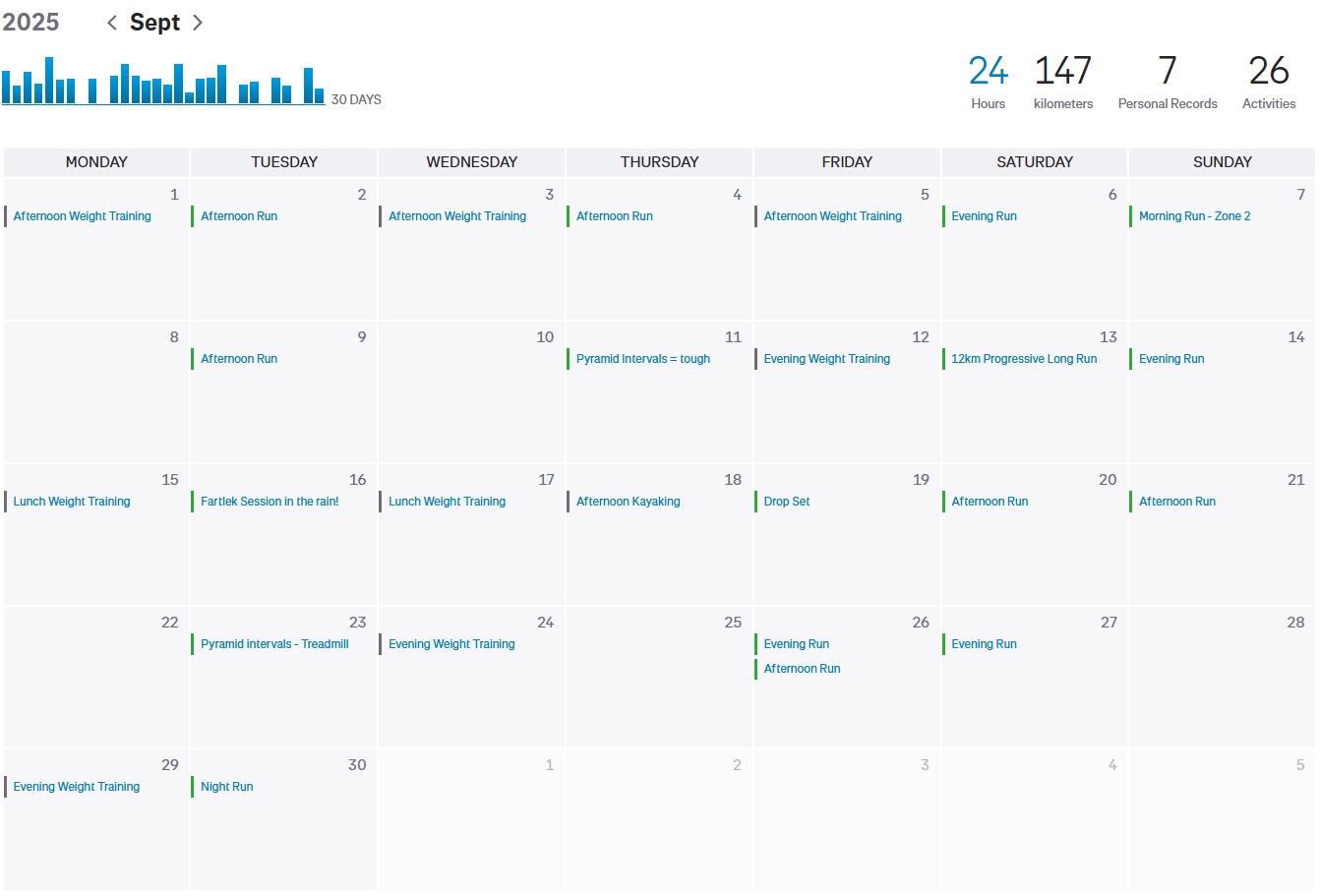
As you can see from the calendar, I had 5 days off during the month so I couldn't fully stick to the planned schedule. Some days I'd just feel knackered and decided to take a rest day, others were unplanned.
Equipment
I spent quite a lot of time trying to figure out what equimpent I needed to support my goal. Here's what I ended up with:-
- Garmin Fenix 8 (watch) - I moved from wearing a Whoop device to Garmin due to better activity tracking capabilities. I use it to track all my runs (and strength training sessions) and I even use it for tracking my sleep and recovery. I don't think I need a Fenix, probably a cheaper Forerunner would have sufficed, but the 16 day battery life and diving support is great.
- Polar H10 (heart rate monitor) - this heart rate monitor gives me a more accurate and reliable data compared to just relying on the readings from my Garmin (or any other wrist sensor).
- Aasics Novablast 5 (training shoe)- training shoe for slower, easy runs and recovery runs - has better stability and cushioning than the Adizero (below)
- Adidas Adizero Adios 8 (speed shoe) - used for speed work, tempo runs and races. Lighter and more agile than max cushion everyday trainers.
- Shokz OpenRun Pro 2 (wireless headphones) - the best running headphones I've managed to find for running. Sits over the ear so you can still hear things like cars, other runners passing by etc. and fits so well that it has never moved or fallen off during a run (I previously had issues with earbuds falling out etc.)
- Salomon Pulse Belt (Running belt) - comfortable belt to carry your valuables while running.

My running shoes:- Novablast 5 on the left and the Adizeros on the right
Apps and Subscriptions
- Strava ($11.99/month) - Strava is a social fitness app that tracks and analyzes your runs while connecting you with a global community - it’s great because it turns training into a shared, motivating experience with detailed performance insights, challenges, and leaderboards that keep you engaged. I connected my Garmin Fenix 8 watch to Strava so that my runs are automatically uploaded and tracked.

Strava is great for keeping a digital record of all your walks, runs and weight training sessions.
- Runna ($19.99/month) - a mobile app that delivers personalized, adaptive training plans built by expert coaches that adjust to your progress and goals, making it easy to train smarter, stay consistent, and improve performance. I had no idea about how to program for a faster 5k so just followed their plan as much as I could.

An example Runna workout
What I Learned from these 3 Months
LSD = Long Slow Distance Runs
It turns out that to run faster then you need to learn to run slow a lot of the time. I've learned that an 80/20 split of slow vs fast runs are generally recommended. So that means that roughly 80% of your mileage should be in zone 2 (more about this below). For me, that means staying below 145bpm and is somewhere between 5 mins per km (12kmh) and 6 mins per km (10kmh).
It's a Bad Idea to Race a 5k Every Week
Here's what an experienced running coach told me:-
"Training is like baking the cake, it’s where you mix the ingredients, apply the heat, and patiently build the foundation, while racing is eating the cake, the moment you get to enjoy the results of all that preparation"
Running all out every week hampers recovery and progression during a training block. I was advised to go "full send" on a 5k only once per month at the max (preferably less)
The Different Types of Race Shoe
Ideally you'd have 3 different types of shoe (I only have 2).
- Training shoe - an every day runner with max cushion for support
- Speed shoe - lightweight and responsive for speed work (tempos/intervals)
- Race shoe - high-performance, often carbon-plated, for maximum efficiency on race day (I don't have this yet)
Heat Makes a Huge Difference
It's harder to run when it's hot. My 5k best time was 20:15 on a flat surface in Asia at around 25°C. Only a week later I ran 19:35 in the UK at around 9°C.
That's a 40 second reduction without any notable change in fitness.
When it's warm the body requires more bloodflow and a higher heart rate to keep cool, so it's harder to keep your BPM under control. I was honestly a bit sceptical that it was going to make such a big difference, but the effect was massive. Even my zone 2 training is faster in the UK vs in Asia.

Dying in 25 degrees heat at 5am in the morning in Asia
Zone 2 Training is Important
In zone 2, your body learns to primarily use fat for fuel as opposed to carbohydrates. Entering zone 3 and beyond, oxygen delivery can't fully meet energy demands, so your muscles rely more on glycogen (stored carbs) for quick energy.
I learned that zone 2 training forces different physiological adaptations than training in higher zones. It increases mitochondrial density, fat metabolism, aerobic endurance and lower resting heart rate. Zone 2 builds a stronger aerobic base.
In short: turns out zone 2 training is super important for our health and longevity but also to potentiate faster running.
Zone 2 Heart Rates are Subjective
The specific BPM window for zone 2 changes from one person to the next.
If you're unable to get tested, then a reliable indicator that you're in zone 2 is to run at a speed that allows you to have a conversation (even though you don't want to) and breathe through your nose.
The gold standard, though, is to get lactate testing in a lab.

Getting my lactate and VO2 max tested in a lab
Lactate testing means getting hooked up to a machine, running at a certain speed for a few minutes and getting your blood tested at each interval. Here are my zones:-

My heart rate zones from lactate testing in the lab
My zone 2 lies between 134 and 146bpm so I try to make sure that my slow runs are in this window for max benefit.
Note that Zone 2 HR can also vary day-to-day depending on heat, sleep, or hydration.
Pacing that First Kilometre
In my first 5k race, I went out like a bat out of hell at 3:35 per km and felt great. Of course, the wheels came off after about 3km and I limped home with a 20:15 mins time. I bombed out! It's so easy to go out way too fast especially with race day adrenaline and excitement.
Remember:- no races have been won in the first km but many have been lost!
For a sub 20 mins 5k, I recommend trying to run as close as possible to 4 mins per km (no faster) for the first few km and then see how you feel mid race. If you're feeling good, then slowly squeeze in the second half of the race for a negative split. Don't get carried away at the start and then hang on for dear life - it's a painful recipe for disaster!
Conditioning Requires Patience
For most of the training block, my calves were constantly battered: tight, sore, and aching almost every day. At times I was hobbling around and genuinely worried that pushing through might turn a niggle into a strain. I wasn’t sure what was causing it, which led me down a rabbit hole of questioning everything - my running form, my shoes, even whether I was built for this at all.
I’m happy to say that as I write this, those calf issues are long gone - even after a 15 km long run this morning. What I’ve learned is that conditioning the body, especially the joints and tendons, takes far longer than building muscle. It just takes time and consistency for everything to adapt. So be patient if you're feeling niggles.
The 10% Rule for Injury Prevention
Running injuries are pretty common due to repeated stress on the body. The most likely cause of injury is doing too much, too soon, causing a rapid increase in volume or intensity that overloads tissues faster than they can adapt.
I've read that the best way to counteract this is the 10% rule:
Increase your weekly mileage or training load by no more than 10% per week, giving your body time to adapt and recover while reducing the risk of overuse injuries.
This has helped keep me injury free and as consistent as possible.
My Best Advice for Running a Sub 20 5k
- Build up slowly over time. Especially true if you're just starting out. It's quite common to get excited at the start, run too much and end up with something like shin splints. Injury risk is real and can completely derail you.
- Don't max out trying to test your pace all the time. Follow a proper training block as laid out by something like Runna and trust the process. Sign up for a race around 8 weeks away, giving you plenty of time to build up your fitness. If you run Parkruns each week, use most of them as tempo runs rather than full sends.
- Track everything. A smart watch + Strava are the gold standard, but even if you're just logging your runs in a spreadsheet it's a great start.
- Choose a suitable race - choose a flat and fast course on race day. Some courses are hilly and totally unsuitable for PR attempts.
- Get a heart rate monitor - a chest heart rate monitor is just way more accurate than wrist based devices. Especially useful if you're just learning your zones.
- Get lactate tested - if you're serious about training, it's useful to know exactly where your zone 2 lies.
How Starting Running Affected my Physique and Health Metrics
Short answer is that I got more ripped, lost about 8kg of mostly fat but also lost a bit of muscle.
The longer answer is a bit more nuanced:-
- The weight loss was planned. I had a blood test done back in April that showed very early signs of a trend towards insulin resistance so weight loss was my main planned intervention. I went from 78kg down to 70kg.
- Definitely lost some muscle and strength. Deadlift went from around 190kg to 170kg. Similar drops in bench and squat. Hard to say if this is from the running or the weight loss or a combination.

At around 71kg. Not exactly jacked but still holding a bit of muscle. Nice to see lower abs again after about 20 years 🙂
In terms of health metrics, they all trended in a positive direction as you would expect.
Here's my lipid profile before (on the right) and after upping the cardio (on the left):-

Note that these markers were taken when I was at 74.4kg, only half way during my weight loss phase. Shortly I'll do another round of testing at my current weight of 70kg
High LDL cholesterol is the main marker when assessing cardiovascular risk so I was extremely happy to see that drop from 136.4 to 88.42. I should note that I did make some dietary interventions aswell (lowered daily saturated fag to < 10g and increased intake of soluble fibre) so this can't be solely attributed to the additional cardio.
Note also that triglycerides dropped from 86.7 to 62.84 - major win.
Other markers also improved:-
- HbA1C - dropped from 5.2 to 5.2

- Fasting Blood Glucose - dropped from 97 to 94.24
- Fasting Insulin - dropped from 6.5 to 2.52
- Visceral fat rating - dropped from 11 to 9
The blood tests are very encouraging and I'm clearly in better health now. I'll post the results of my final blood test at 70kg when I have them.
My Next Goal...
Well it's got to be sub 19 mins for 5k, hasn't it?
My stretch goal is to be an England Masters runner.
Here are the England Masters standards for the 10k:-

According to this VDOT calculator, to be able to run 34:45 for 10km then I'd need to do 5km in 16:44.
That's pretty bloody quick and means reducing my 5k time by around 3 minutes.
I'd need to give it years and probably at least triple my current weekly volume to have any chance at all. I put my chances of achieving this goal at 10% or less - but I do love a challenge, so I'm gonna go for it!
